
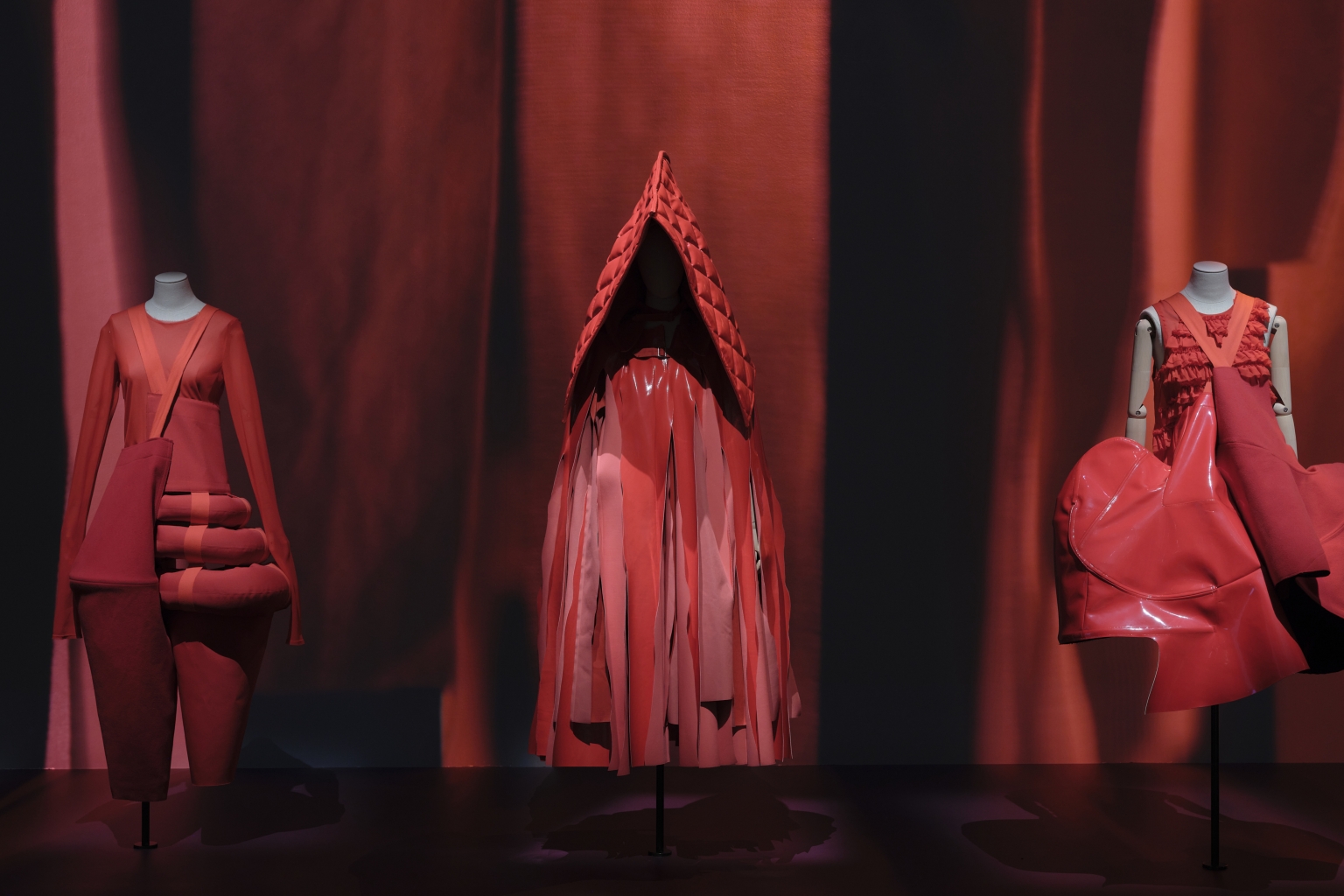
The 1970s marked a major pivot in the fashion world, one that would reframe the industry, redefine the standard of dressing, and send shockwaves rippling through the cultural zeitgeist. It was a decade of disruption; economically uncertain, politically charged, and creatively explosive—which meant the fashion status quo didn’t stand a chance. Amid this sartorial shake-up, two designers—oceans apart yet unknowingly marching to the beat of the same rebellious drum—were quietly (and sometimes loudly) carving out the next era of style.
Keep up to date with all things arts, exhibitions and stage here.
View this post on Instagram
In London, Vivienne Westwood emerged as the undeniable architect of punk fashion. Her approach was part performance art, part political protest, and entirely unapologetic. With safety pins, ripped tartan, fetish influences, and DIY grit, she transformed clothing into a rallying cry. Every garment dared you to challenge authority, question conformity, and choke on the idea that fashion had to be polite. Westwood wasn’t just designing clothes; she was designing cultural rebellion.
Meanwhile, in Tokyo, Rei Kawakubo was reshaping fashion’s future from an entirely different angle—intellectual, architectural, and quietly volcanic. Through her label Comme des Garçons, she embraced asymmetry, deconstruction, negative space, and silhouettes that seemed to defy physics, let alone trends. Kawakubo wasn’t interested in flattering the body; she was interested in provoking thought. Her work was a question, a challenge, and occasionally a puzzle people weren’t sure they were meant to solve.
Though their aesthetic languages were worlds apart, Westwood and Kawakubo shared a crucial throughline: both were outsiders who rewrote the rules simply by refusing to acknowledge they existed. Their parallel rise signalled a radical shift—fashion was no longer just about dressing the body. It had become a vehicle for ideology, identity, tension, and transformation. In that turbulent, thrilling decade, both designers helped usher in a new understanding of what clothing could say, and just how loudly it could say it. Now, their intricate works intersect in a world-premiere pairing at the National Gallery of Victoria (NGV), Australia’s oldest and most forward-thinking art museum. It’s a creative collision that feels both overdue and electric: two designers who reshaped global fashion history finally examined side by side.
Guiding this vision is NGV Curator of Fashion and Textiles Danielle Whitfield, alongside Senior Curator Katie Somerville. Rather than a straightforward retrospective, the duo approached the project as a dialogue—a cross-continental conversation built from decades of rebellion, reinvention and radical design thinking. Westwood | Kawakubo emerged not from a single idea, but from deep within the gallery’s archives, stitched together piece by piece. With the first Westwood item entering the NGV collection in the 90s, this exhibition is a statement three decades in the making.
View this post on Instagram
Between assembling and refining the exhibition, Whitfield paused to share the curatorial intent behind the pairing, revealing the threads—both bold and unexpected—that link these two visionary forces and bring their creative worlds into sharp, dynamic focus.
“It’s curated from the position of looking at our own fashion holdings, thinking about those collection strengths, and then building an exhibition that pairs two great artists in dialogue to consider their practices and their legacies. There are about 300 Comme des Garçons pieces in the collection, and about 100 Westwood pieces, so we were thinking about an exhibition that would feel major,” explains Whitfield.
“The NGV has an exhibition model that looks at leading artists in parallel, but we’ve never done an exhibition of this kind featuring women, and we’ve never done fashion, so it was an opportunity to work within an established context but also to think differently about those figures in in-depth detail. We were in incredibly fertile territory with two fashion rebels – they’re uncompromising, they’re independent, they’re self-taught and they were born within a year of each other. They also occupy the same sort of temporal space in terms of when they began their careers, the impact, and the influence that they have had, and their preoccupations. Both designed with a desire to really change the status quo, to think about what fashion means, particularly for women, and to look at the limitations of gender codes and conventional beauty. They reimagined and reframed those possibilities, shaping the way we think about the relationship between body and garment.”
From Naomi Campbell’s unforgettable fall in towering nine-inch Westwood heels to the cultural imprint of Carrie Bradshaw’s bridal gown, Vivienne Westwood’s work often arrived wrapped in spectacle. Buffalo Girls, Pirate, Kate Moss licking an ice cream bare-chest mid-runway—her collections fed the legend of a designer who delighted in breaking the rules and bending the moment to her will. Rei Kawakubo carved her own path of disruption. From the boundary-pushing silhouettes of Body Meets Dress, Dress Meets Body to the distortions of Lumps and Bumps, and the experiential art-meets-fashion retail world of Dover Street Market, her designs seemed to reject convention at every turn. To the public, she was the inscrutable provocateur reshaping fashion’s very vocabulary.
Yet, behind the headlines, shockwaves, and spectacle, both designers shared something far quieter: an unwavering devotion to craft. Beneath the rebellion lived deep technical mastery—precision tailoring, rigorous construction, and a lifelong commitment to expanding the language of fashion through skill as much as subversion.
View this post on Instagram
“They were both deep thinkers and they’re such curious minds and the work that they produce is often very technically complex but also challenging. Both being self-taught artists, there is so much effort that has gone into their skill development and is put into each garment and design. The stitches, the cuts, the silhouettes, the structure – every inch of a design has been meticulously thought out and exquisitely executed,” explains Whitfield.
“There’s always intentionality. They are both masterful technicians.”
To build these convergences and divergences through an exhibition narrative, NGV’s Westwood | Kawakubo has been divided into five overarching thematics; Punk and Provocation, Rupture, Reinvention, The Body, and The Power of Clothes. Each garment has been selected to feed into these dialogues.
“We started by looking at the most important collections over the course of their careers. Particularly for Westwood we centred it on the 80s through to the early 2000s, and with Kawakubo we focused on her latter career. It’s about being led by the preoccupations of the artists themselves and then from there, selecting those moments that we felt were the strongest for the NGV.”
View this post on Instagram
With a vibrant line-up of public programs — from intimate Member Talks and drop-in conversations to a rare millinery masterclass with Stephen Jones and the electric energy of NGV Friday Night live music — Westwood | Kawakubo becomes far more than an exhibition. It’s a fully immersive celebration of style and subversion; a living, breathing dressing of defiance.
“This show is looking at the brilliance of what fashion is and convey what it meant in particular times and how these two designers changed the course of history not only through fashion but in culture, in music, in politics and activism. It’s an incredible celebration of two trailblazing designers.”
Westwood | Kawakubo opens at NGV International on Sunday 7 December 25 and runs until Sunday 19 April 2026.*
*Please note this is a ticketed exhibition.
The current most read stories on Forte

3 June 2026
Her Majesty’s Theatre Ballarat is alive with performances this June, offering comedy, theatre, and music that span intimate storytelling to…
3 June 2026
Cindy Tong has been on our radar for a while. The ceramic artist and potter from Gippsland has developed a…
2 June 2026
This winter, Chadstone is stepping beyond the shopping bag and into the spotlight, unveiling Light to Night, a month-long festival…
2 June 2026
Today, Melbourne’s trams take on a new life, gliding through the city as moving works of art. The First Peoples…
1 June 2026
I’m back in the saddle again. Well, perhaps not a saddle. That would require a certain level of poise, grace…
29 May 2026
Winter on the Bellarine has always carried a certain romance. Salt-heavy air curling off the bay. The skeletal beauty of…
22 May 2026
Geelong-based photographer Jane Fitzgerald invites viewers to step into a world that lies just beyond the visible with Unseen, her…
22 May 2026
If festivals had a playbook, the National Celtic Folk Festival would have written it. A celebration of music, arts, lifestyle,…